On your laptop
Everything is kept in one SQLite file. Add --memory for a clean start every run, like in CI.
Lookalyke runs lookalikes of Stripe, Twilio, OpenAI and the other services your app calls, right on your machine. Watch every request, reply to texts as the customer and make payments fail on purpose, with no real money or messages involved.
Hi Dana, invoice #1043 is ready to pay.
message.received → localhost:8787Open a service for its local endpoint, environment variables, and a sample request.
No accounts to make and no test keys to request. Start it, point your app at it, then use your app.
Run from a checkout with Node.js 22.14+ and pnpm 12. Each service gets its own address on one port, with the dashboard beside them.
git clone https://github.com/jviars/lookalyke.git &&
cd lookalyke &&
pnpm install --frozen-lockfile &&
pnpm build &&
node packages/server/dist/cli.js --memory --democurl -fsS http://127.0.0.1:4100/_lookalyke/health
{"ok":true,"version":"0.1.0"}Swap the base address and key for each service. The dashboard’s Connect tab gives you the lines to paste. See SDK setup.
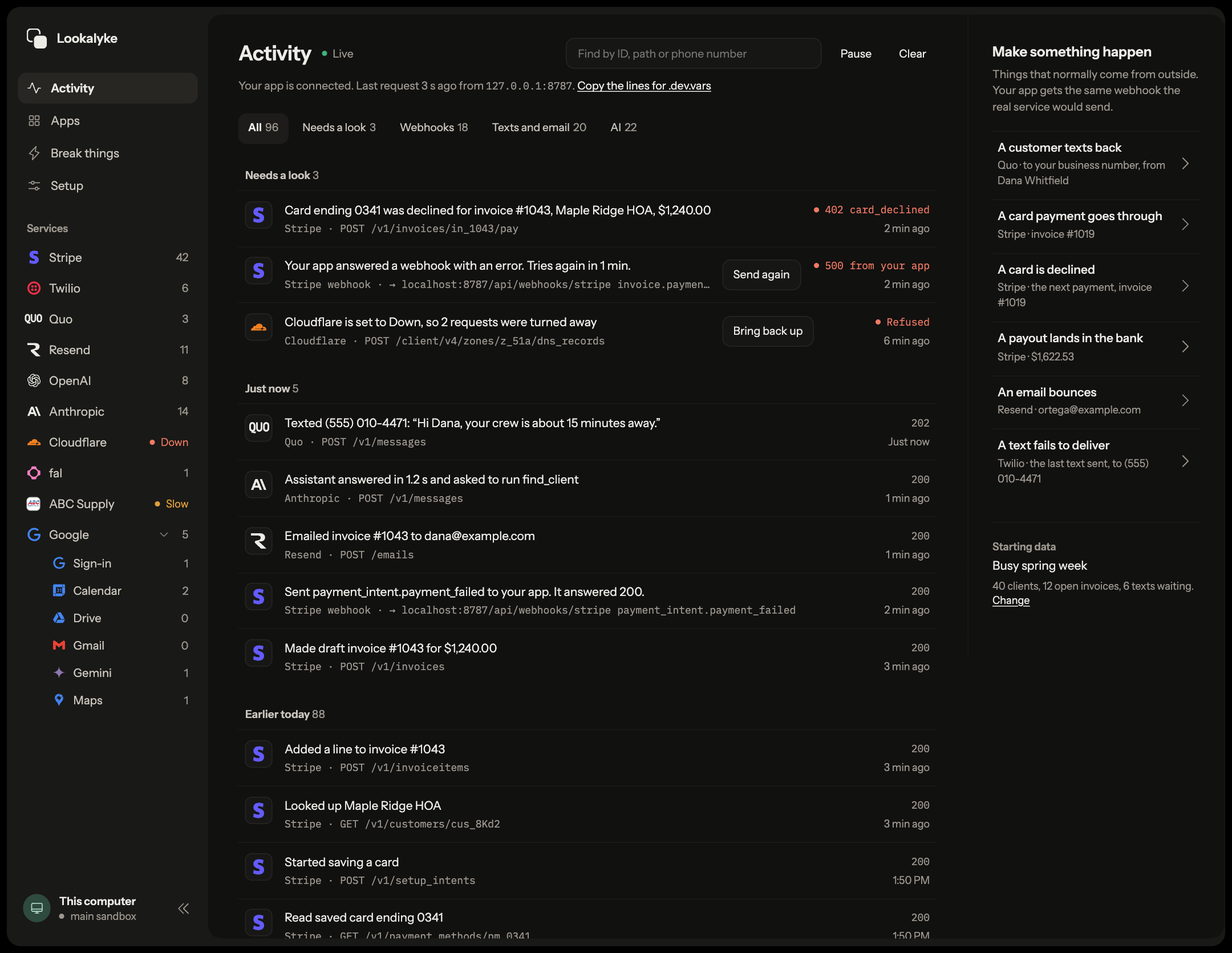
- RESEND_BASE_URL=https://api.resend.com+ RESEND_BASE_URL=http://127.0.0.1:4100/resend- RESEND_API_KEY=<provider key>+ RESEND_API_KEY=<Lookalyke sandbox key>Click through your app, then open Activity to see what it sent, what came back and how long it took.
Made draft invoice #1043 for $1,240.00
Stripe · POST /v1/invoices200
84 msEmailed invoice #1043 to [email protected]
Resend · POST /emails200
61 msDeclined cards, late webhooks, customers who text back, services that go down. Make each one happen when you want it, as often as you want.
See what your app sent and what came back. Failed calls rise to the top so you can open them and try again.
Read texts and emails your app sends, and reply directly as the customer to trigger real inbound webhooks.
Make any vendor slow, return 500s, or drop connections—and verify your retry logic holds up.
Fire incoming webhooks, declined cards, or bounced emails with one click instead of waiting on external events.
Every branch or teammate gets isolated keys, data, and webhook URLs so tests never collide.
Everything is kept in one SQLite file. Add --memory for a clean start every run, like in CI.
Build one image with the dashboard and every service. Mount a volume to keep your data between restarts.
Give your team a shared copy with owner sign-in and persistent storage. Open it from your Railway address.
Deploy on RailwaySomething missing? Ask on GitHub.
No. Use Lookalyke for the everyday loop of building and clicking around. Before you ship, run your checks against each service’s own test mode too.